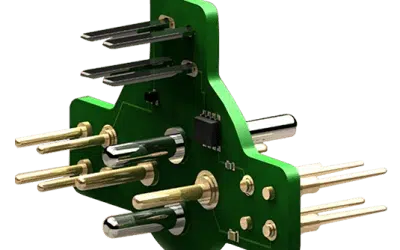
Magnetic Connectivity for Patient Monitoring Devices

Did You Know? Better Patient Monitoring Connectors Start With Usability
By Dennis Johnson,
General Manager & Chief Technology Officer, Onanon
In patient monitoring systems, connectors are easy to overlook until they slow clinicians down or frustrate patients. These devices are used constantly, often under time pressure, and sometimes by patients themselves. That makes connector design a matter of safety, reliability, and experience, not just mechanical fit.
At Onanon, we focus on how connectors perform in real clinical environments. As Dennis Johnson, General Manager and CTO at Onanon, recently demonstrated, traditional connectors often struggle when used with mobile patient monitoring equipment.
Where Traditional Connectors Fall Short
Many patient monitoring devices rely on circular or latch-based connectors that require precise alignment and applied force. When these devices are mounted on rolling stands or positioned near a patient’s bedside, connecting and disconnecting can be awkward. Nurses may need two hands, patients have difficulty disconnecting on their own, and improper alignment increases wear over time.
Repeated twisting and pulling can damage both the connector and the device housing. In patient monitoring applications, that wear can lead to inconsistent signals, higher maintenance needs, and unnecessary downtime, all of which disrupt care.
A More Intuitive Approach With Magnetic Connectivity
A More Intuitive Approach With Magnetic Connectivity
MagConnect® approaches the problem differently by using precision magnetic alignment. Instead of requiring users to visually line up pins or apply insertion force, integrated magnet arrays guide the connector into proper orientation and seating. The magnetic field provides self-centering alignment within tight positional tolerances, reducing the risk of pin damage, misalignment, or partial engagement. Connection force is minimized because the magnets perform the alignment work, allowing single-handed operation even in constrained bedside environments.
Breakaway retention force can be engineered to match specific application requirements. For example, low-retention configurations (approximately 0.5–1.5 lbf / 2–7 N) are well suited for wearable or ambulatory monitoring devices where patient safety and rapid disconnect are priorities. Medium-retention designs (2–4 lbf / 9–18 N) provide secure engagement for bedside monitors that may experience incidental cable movement but still require safe release if pulled. Higher-retention configurations (5+ lbf / 22+ N) can be specified for stationary or equipment-mounted applications where vibration resistance is more critical than quick patient-driven disconnect.
This tunable retention profile allows OEMs to balance secure electrical performance with controlled breakaway behavior. In the event of an accidental cable pull, the magnetic interface separates cleanly along the mating axis, protecting both the device housing and internal solder joints from mechanical stress.
Magnetic alignment also reduces insertion wear compared to friction- or latch-based systems, extending mating cycle life and maintaining consistent electrical performance over time.
Why This Matters in Patient Monitoring
Patient monitoring is one of the fastest-growing areas in medical electronics, and reliability is critical. Connectors must handle frequent mating cycles, maintain signal integrity, and remain easy to use across different caregivers and patient conditions.
Magnetic connectors help meet these demands by improving alignment consistency, reducing wear, and simplifying interaction. MagConnect® is suitable for both reusable systems and cost-sensitive disposable applications where ease of use and safety are equally important.
Hear about this from Dennis Johnson: https://studio.youtube.com/video/EcxKIcFtN5o/edit
Engineering Connectivity You Can Trust
Connector selection impacts usability, safety, device longevity, and total system cost. As patient monitoring devices continue to move toward more mobile and patient-centered designs, intuitive connectivity becomes a real advantage.
Onanon works directly with OEMs to integrate MagConnect® into patient monitoring systems in a way that supports both engineering requirements and real-world clinical use. If you are planning a design refresh or developing a new monitoring platform, our engineering team is ready to help.
FAQ
Q: What is breakaway retention force in medical connectors?
A: Breakaway retention force is the amount of pull force required to safely disconnect a connector. In medical applications, it is engineered to balance secure signal integrity with patient safety.
Q: Why are tunable magnetic connectors beneficial in patient monitoring?
A: They allow OEMs to match retention strength to use cases such as wearable, bedside, or stationary equipment, improving safety and durability.
Visit Onanon.com to learn more or to schedule a technical discussion.